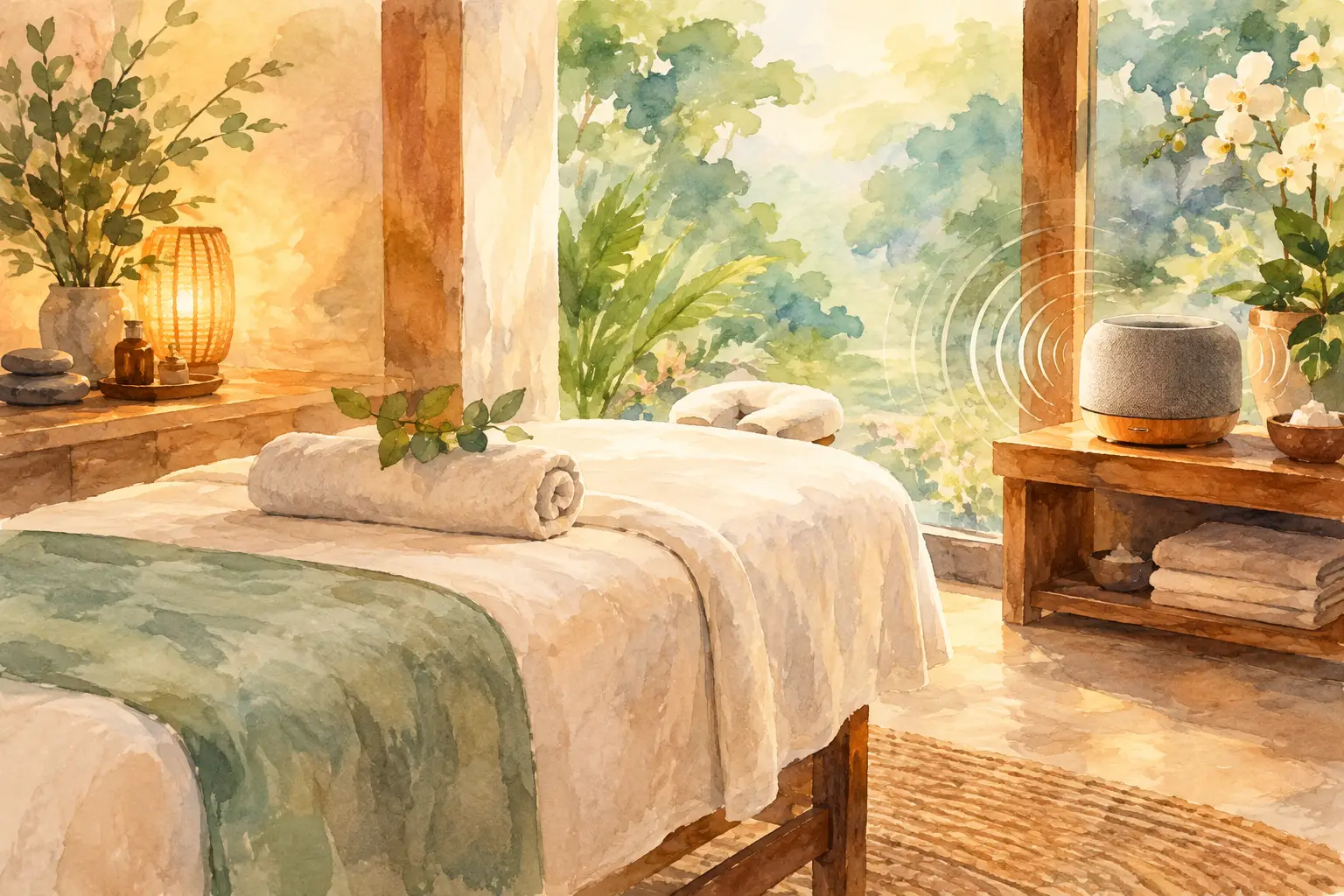
A treatment room can be beautifully designed and still feel unsettled if the music keeps asking for attention. A vocal enters halfway through a massage. A track ends in a moment of silence. The low end suddenly doubles in weight. Learning how to build spa soundscapes means designing around those small interruptions before they reach the guest.
The goal is not to make music disappear. It is to let music hold the room: warm enough to soften the edges, spacious enough to leave room for breath, conversation, water, and touch. For a therapist or spa operator, that also means less time reaching for the volume control and less concern about what the next song might do.
Start with the treatment, not the genre
“Spa music” is too broad to be useful on its own. A bright reception area, a quiet facial room, a couples massage suite, and a late-afternoon relaxation lounge all need different amounts of motion, warmth, and space.
Begin with the practical shape of the session. A 60-minute massage should not be programmed like a three-hour lounge service. If you have back-to-back appointments, build a longer sequence than a single treatment requires. That buffer prevents the final track from becoming an operational problem when a session runs a few minutes long.
Think about the energy of the room in simple terms. Arrival music can carry a little more light and movement. During treatment, slower harmonic changes and a stable pulse tend to sit more naturally beneath the experience. The final minutes can become slightly more open and weightless, without turning sentimental or suddenly quiet.
Genre is secondary. Ambient, soft electronic, modern instrumental, gentle piano textures, and restrained chillout can all work. What matters is whether the tracks behave well together over time.
Build a reliable sonic foundation
A useful spa soundscape has continuity. That does not mean every piece should sound identical. It means the listener should not feel the joins.
Start by choosing a tonal center. Warm pads, soft keys, distant guitar-like textures, delicate percussion, and low, rounded bass often create an easy foundation. The low end matters more than many people expect. Too little and the room can feel thin or cold. Too much and it can compete with the physical quiet of a treatment, especially on smaller speakers.
Keep dynamics controlled. A soundtrack with dramatic rises and falls may be beautiful on headphones, but it can be distracting in a spa room. Look for compositions that develop patiently rather than relying on a sudden beat drop, a cinematic swell, or a sharp change in density.
Vocals require extra care. Even wordless voices can pull focus when a guest is trying to rest. Lyrics are more disruptive still because the mind naturally begins to follow language. Instrumental programming is usually the safest choice for treatments, particularly when the same playlist will be used all day.
Choose sounds that leave room
The best arrangements for wellness spaces often have intentional gaps. A soundscape does not need to fill every second with bells, birds, rain, or melody. Too many foreground details can make a room feel busy, even at a low volume.
Listen for open space between phrases. Notice whether the melody repeats insistently, whether high frequencies sparkle too sharply, and whether percussion has a hard attack. These details can seem minor at first, then become tiring after the third appointment.
A good test is to play the music while you prepare the room. Fold towels, run water, arrange oils, and move around. If the tracks keep pulling your attention away from those small tasks, they will probably pull at your guest as well.
Sequence for the full appointment
The difference between a collection of pleasant tracks and a real spa soundscape is sequencing. Each transition should feel like a change in light, not a change of channel.
Place your most grounded music near the beginning. The first few tracks establish trust in the room. Avoid opening with something overly delicate that might feel absent, or overly rhythmic that might feel like a lobby playlist. A calm pulse, a warm chord bed, or a slowly unfolding instrumental gives the session a settled starting point.
From there, vary texture without changing the emotional temperature. If one track has soft piano, the next might use a wider pad or gentle hand percussion, but it should retain a similar pace and loudness. Contrast is welcome when it is subtle. A completely different sonic world every four minutes is not.
The final section deserves its own attention. End with tracks that feel resolved but not theatrical. You are creating a graceful return to the room, not a movie ending. A quiet, unhurried close leaves space for the practitioner to speak, for the guest to take their time, and for the next part of the visit to begin naturally.
For longer services, avoid looping a short playlist. Repetition becomes obvious faster in a quiet environment, especially for staff who hear the program every day. Build enough depth that the soundscape can last through a shift without returning to the same few familiar moments.
Set volume once, then protect the atmosphere
Volume is part of composition. Even well-chosen music can become intrusive when it is played too loudly, and a low volume will not rescue a track with harsh highs or oversized bass.
Set the level when the room is in its normal working state. Turn on the fan or water feature if those are part of the experience. Stand where the guest’s head will be, then move to the door and the therapist’s working position. A volume that feels right beside the speaker may feel different on the table.
Once you find the level, resist constant adjustments. Stable loudness from track to track is one of the most practical qualities in a treatment playlist. It lets staff focus on the person in the room rather than the device in their hand.
Speaker placement matters too. A single speaker aimed directly at the table can create a narrow, overly present sound. If your room allows it, aim speakers across the space or use a setup that distributes sound gently. Keep speakers away from places where vibration can travel into furniture, cabinetry, or the treatment table.
Test your spa soundscape in real conditions
A playlist is not finished when it sounds good on a phone or studio headphones. Test it in the space where it will live.
Run the full sequence during a quiet period and listen for practical problems: a track that arrives louder than the rest, a high chime that feels sharper in the room, a pause between songs, or a transition that suddenly changes the mood. Check it again at different times of day. Natural light, street sound, a busy reception area, and evening quiet all change how music is perceived.
Ask your team for specific feedback instead of a general thumbs-up. Which moments felt too active? Did any track make them want to skip ahead? Could they work through two appointments without becoming fatigued by it? Staff experience is useful because they know the playlist more intimately than any guest will.
If you are working from a curated suite, listen through it once before making changes. Long-form programming is often sequenced with transitions, pacing, and consistent loudness in mind. For massage rooms, you can listen to Locuorio’s Weightless Suite on Spotify as a reference for the kind of patient, uninterrupted arc that supports a full treatment rather than a single mood.
Keep separate programs for separate rooms
One playlist rarely serves every space well. The reception area can tolerate a little more rhythm and presence because guests are arriving, speaking, and moving. A treatment room needs less definition and fewer surprises. A relaxation lounge may sit somewhere between the two.
Create a small set of dependable programs rather than endlessly editing one giant list. Give each one a purpose: arrival, treatment, post-treatment, or evening lounge. That makes choices easier for staff and keeps the musical identity of each room clear.
Review them seasonally, or when you notice that a sequence has become too familiar. Refreshing does not require replacing everything. Swapping a few tracks while preserving the same pace, tonal balance, and overall length can keep the room feeling alive without losing the atmosphere you worked to establish.
The best spa soundscape is rarely the one guests comment on most. It is the one that lets them notice the warmth of the room, the care in the details, and the quiet around them. If you want more long-form instrumental music built for that kind of listening, follow Locuorio on Spotify and return when the room needs a new shade of calm.