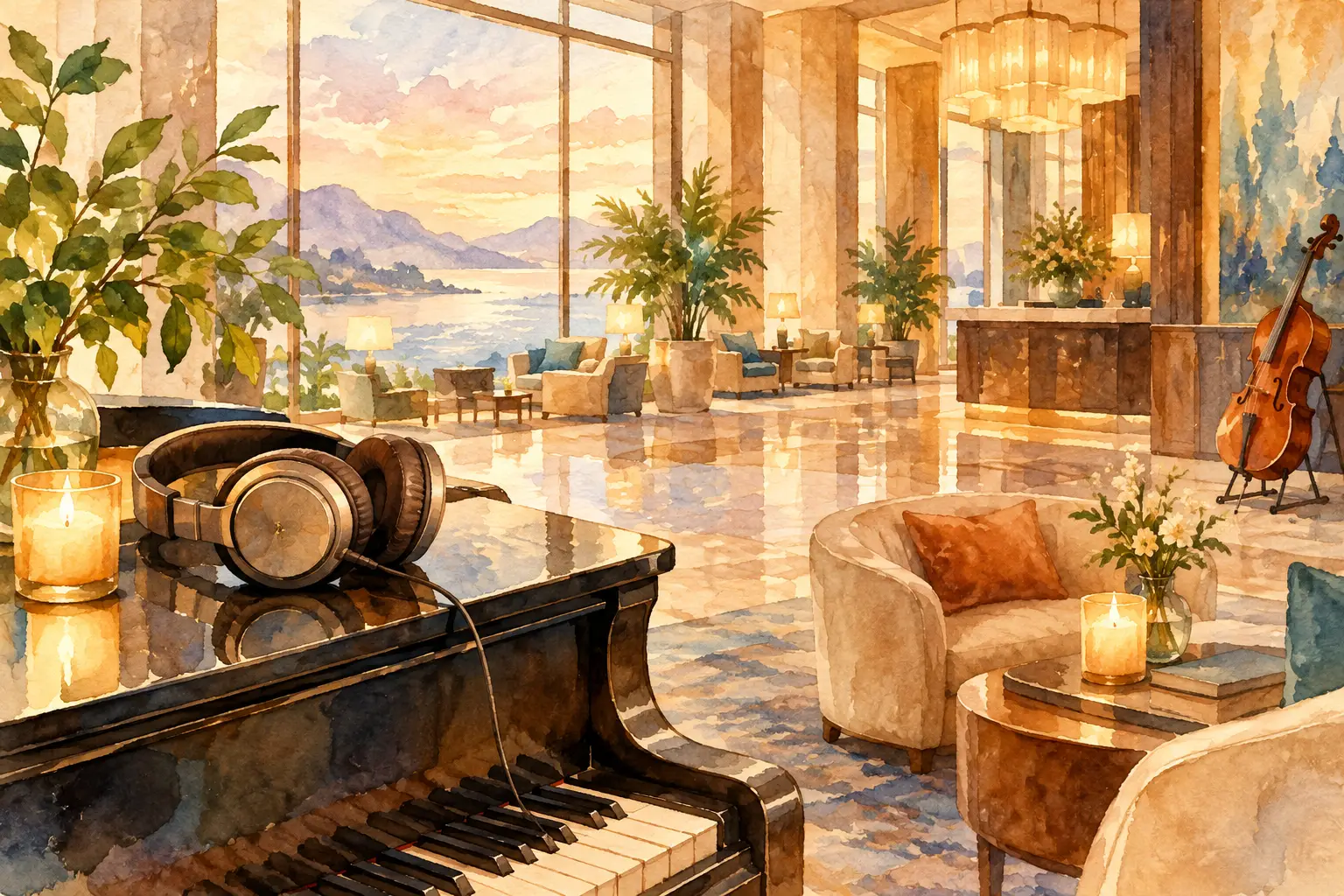
A guest forms an impression before reaching the front desk. The lighting, the scent, the pace of the staff, and the first few seconds of hotel lobby music all say something about the stay ahead. Silence can feel unfinished. Music that is too loud, too familiar, or too restless can make a beautiful room feel smaller.
The right selection does not demand attention. It gives the room a pulse. It helps early arrivals settle into a chair, supports a brief wait at reception, and lets conversations remain the focus. For hotels, that is not a minor detail. It is part of the welcome.
What Hotel Lobby Music Needs to Do
A lobby is not a nightclub, a restaurant, or a spa, though it may borrow a little from each. It has changing traffic, mixed ages, different cultures, rolling luggage, business calls, family reunions, and quiet moments between check-ins. Music has to hold all of that without trying to become the event.
That usually means choosing instrumental or lightly vocal music with a clear but unhurried identity. The sound should feel considered from the first track, yet remain easy to live with across a long shift. A guest should notice the atmosphere, not feel trapped inside someone else’s playlist.
For me, the most useful lobby programming has warmth in the low end, patient harmony, and enough open space for the room to breathe. A soft bass line can add confidence. A gentle melodic phrase can add color. But sharp vocal hooks, dramatic drops, sudden silence, and wide swings in energy tend to interrupt the work a lobby is doing.
There is a trade-off here. Music that is completely neutral often becomes anonymous, while music with too much personality can compete with the architecture and service. The goal is not invisibility. It is a distinct atmosphere with good manners.
Start With the Room, Not a Genre
The question is not simply whether a hotel needs lounge, ambient, jazz, electronic, or acoustic music. The question is what the space asks of music at a particular hour.
A compact boutique lobby with dark wood, low lamps, and an evening bar can carry a deeper groove and a little more melodic movement. A coastal resort lobby with daylight and open air may need brighter textures, lighter percussion, and a slower sense of time. A business hotel near an airport benefits from clarity and consistency: music that feels composed while guests are checking schedules, taking calls, and moving quickly.
Genre labels are useful shortcuts, but they do not solve the operational problem. Two lounge tracks can feel completely different in a room. One may have a warm, steady rhythm that supports conversation. The other may lean too heavily on a vocal sample or a snare that cuts through the front-desk exchange. Listen for behavior, not just style.
A good test is simple: play the music at real lobby volume while someone speaks from the reception desk. If the music makes speech feel less clear, it is doing too much. If it disappears completely and leaves the room feeling flat, it may not be doing enough.
Favor continuity over surprise
A hotel lobby rarely benefits from abrupt transitions. Guests may hear only two minutes while waiting for a key, but staff hear the entire day. That makes sequencing as important as individual tracks.
Look for a program with compatible tempos, related tonal colors, and stable perceived volume. The point is not to make every track sound identical. Small shifts keep the room alive. But the shifts should feel like a change in daylight, not a door slamming.
Long-form programming is especially practical because it reduces the need for someone at the desk to adjust volume, skip a track, or rebuild a queue during a busy arrival period. A carefully paced suite gives staff one less small decision to make.
Tempo and Texture Set the Social Pace
Tempo influences a lobby long before guests identify it consciously. Faster music can add movement, which may suit a crowded breakfast period or an active bar-adjacent reception. But sustained high energy can make a waiting area feel impatient. Slow music can feel luxurious, but if it is too sparse or heavy, it can pull a daytime lobby downward.
A moderate pulse is often the most flexible answer. Think restrained electronic percussion, soft hand-played rhythms, gentle chords, and melodic details that arrive without insisting. This kind of music supports circulation. It gives a space shape without setting a single emotional script for every person who enters.
Texture matters just as much. Bright, brittle highs can become tiring in a lobby with stone, glass, and other reflective surfaces. Warm pads, rounded percussion, low-key keys, and soft guitar or synth detail usually travel more comfortably through those rooms. The music should still have definition, especially near a desk or bar, but it does not need to sparkle at every second.
This is why tracks made for focused listening do not always work in hospitality. A compelling headphone moment can have too much contrast for shared space. Hotel music needs a wider patience.
Treat Volume as Part of Service
Volume is where a carefully chosen playlist can fail. A track may sound elegant at a desk speaker and feel intrusive once it reaches the seating area, elevator bank, and check-in line.
Set the level for the busiest part of the lobby, not the emptiest. If staff and guests need to raise their voices, lower it. If the room feels vacant when only a few people are present, a modest increase may help. The best setting often feels slightly quieter than the manager expects when standing close to the speaker.
Consistency is equally important. Music with uneven mastering creates a cycle of constant adjustment: one song fades into the background, the next jumps forward, and the desk team reaches for the controls. Reliable loudness lets the atmosphere stay stable even when the lobby changes around it.
Speaker placement has a role, too. One loud source near the reception desk can make employees fatigued while leaving corners of the lobby silent. Distributed, lower-level sound is usually kinder to both guests and staff. If the system cannot be changed, choose gentler arrangements rather than compensating with more volume.
Build Around the Day, Not a Single Mood
A lobby has dayparts. Morning asks for clarity. Afternoon often needs a relaxed, useful rhythm. Evening can hold more depth, especially where the lobby blends into a lounge, terrace, or bar.
That does not mean every hour requires a separate musical identity. In fact, too much contrast can make the hotel feel inconsistent. Keep the same sonic family, then let the energy move gradually. Morning may favor open harmonies and lighter movement. Late afternoon can add a warmer beat. Evening can bring a slightly deeper bass line and more golden-hour color.
The LOUNGE playlist from Locuorio was built with this kind of room in mind: original chillout and lounge selections that can sit behind conversation rather than crowd it. Its pacing is intended for extended listening, with restrained dynamics and no need for constant intervention.
Seasonality can add another layer, but it should not become a costume. A winter lobby may welcome richer tones and slower melodies; summer can make room for airier rhythm and brighter detail. The core should remain recognizably yours.
Give the Team a Simple Listening Standard
Even excellent music loses its value when different staff members change it according to personal taste. A concise internal standard keeps the experience coherent: instrumental or low-vocal music, steady volume, no explicit content, no abrupt genre changes, and no high-intensity tracks during core check-in hours.
It also helps to define one person who can make changes after listening in the actual room. Not on a phone, not through office speakers, but in the lobby at the times guests use it. Ask the team where conversations become difficult, when the space feels too quiet, and whether certain tracks pull attention away from service.
The strongest hotel lobby music is rarely the most dramatic music in the catalog. It is the music that continues to feel right after the hundredth guest has arrived. It respects the room, the people working in it, and the guest who only has a few minutes to decide how the hotel makes them feel.
Choose music with enough character to be remembered as a feeling, not as an interruption. If you are shaping a lobby, terrace, or bar atmosphere, spend time with Locuorio on Spotify and follow for more patient, room-ready listening.