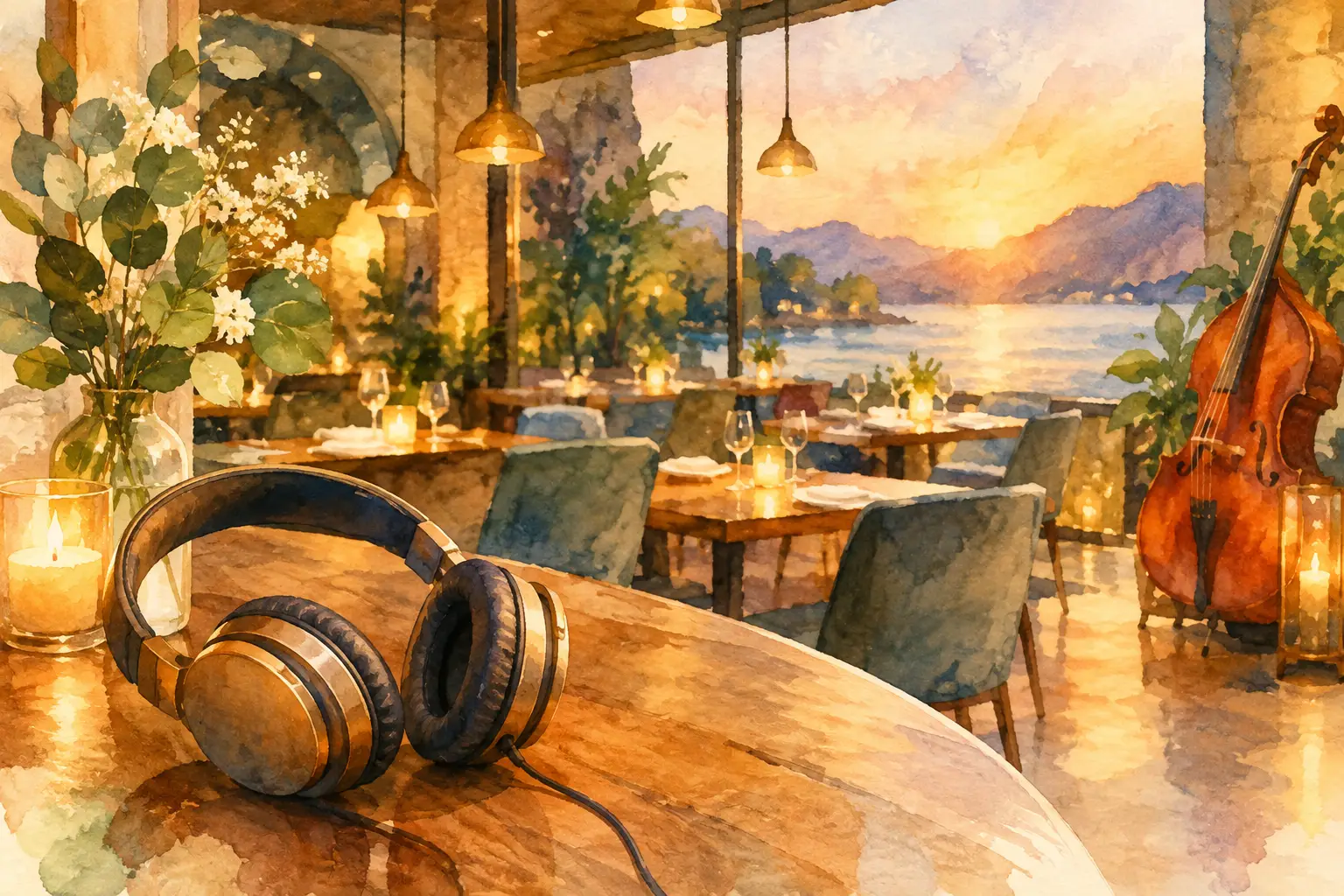
A dining room can look perfect and still feel unsettled. The lights are warm, the tables are set, the first plates leave the pass, yet something keeps the room from landing. Often, it is the sound. Restaurant background music is not decoration added after the fact. It is part of the pacing of service, the space between conversations, and the feeling guests carry with them when they leave.
The right selection does not ask to be noticed track by track. It gives a room a center. It can make a quiet Tuesday lunch feel gently occupied, help a terrace stay loose as afternoon turns to evening, or let a busy dinner service feel energized without becoming loud. That is a subtle job, but not a small one.
Restaurant Background Music Sets the Pace
Guests take cues from more than the menu. Tempo, volume, and texture quietly suggest how a room wants to move. A brisk, prominent beat can make a casual counter-service spot feel lively. In a dining room built around long meals and thoughtful wine service, that same beat may create pressure where patience is part of the experience.
This does not mean every restaurant needs slow ambient music. It means the sound should agree with the occasion. A daylight cafe may want soft grooves with a little lift. A hotel restaurant may need polished, unobtrusive warmth that can sit behind breakfast, meetings, and dinner. A late-night bar with food may allow more pulse, especially after the kitchen settles into its evening rhythm.
The question is not simply, “What music do we like?” It is, “What should this room feel like at this hour?” That distinction prevents a playlist from becoming an employee’s personal listening session. Good background programming serves the guests, the staff, and the pace of the floor.
Start With the Room, Not the Genre
Genre labels are useful, but they are rarely enough. Two lounge tracks can produce entirely different results: one may feel sunlit and open, while another is too dramatic for a room where people are trying to hear one another. A melodic house track can work beautifully on a terrace, but only if its energy stays controlled and its transitions do not pull attention away from the table.
Begin with the practical character of the space. Consider the ceiling height, hard surfaces, number of seats, average party size, and how close tables are placed. A small room with tile, glass, and bare walls tends to amplify sharp percussion and bright vocals. It often benefits from warmer low end, restrained high frequencies, and arrangements that leave air around the melody.
Then consider the food and the service style. A neighborhood bistro, a refined dining room, a bakery with a lunch rush, and a rooftop cocktail terrace do not need the same musical temperature. The goal is not to make the music match a stereotype. It is to make it feel native to the room.
Build Around Service, Not a Single Mood
One playlist for an entire day is convenient, but convenience can become flatness. Restaurant background music works best when it follows the natural arc of service. Opening hours need presence without insistence. Lunch often benefits from a brighter pulse. Dinner can become deeper, warmer, and more spacious. Later hours may invite more rhythm, provided the music still leaves room for conversation.
Think in blocks rather than chasing individual songs. A two- to four-hour sequence gives the team fewer decisions to make and gives guests a more coherent experience. Long-form programming also prevents the familiar problem of hearing the same handful of tracks every shift. Repetition is especially noticeable to staff, who may hear the soundtrack far more closely than guests do.
For a restaurant that changes character throughout the day, prepare separate programs for breakfast or opening, lunch, early dinner, and late evening. They do not need to be radically different. A gradual change in tempo, density, and color is usually more effective than an abrupt jump from soft acoustic tracks to club-ready electronic music.
Keep the Transitions Quiet
A good transition is often one nobody comments on. Sudden genre shifts, dramatic intros, silence between tracks, or major changes in loudness can break the spell of a room. They force attention toward the speakers just when the music should be doing its work in the background.
Look for music with consistent perceived loudness and patient transitions. Instrumental selections are often easier to place across a full service because they do not compete with conversation or introduce lyrics that guests may find distracting, overly familiar, or mismatched to the setting. Vocals are not always wrong, particularly in casual daytime concepts, but they should be chosen with more care.
Volume Is an Operational Choice
Restaurants often adjust volume by instinct, usually when the room already feels too loud or too empty. A better approach is to set a baseline before service and make small changes as the room fills. What sounds barely audible in an empty dining room can become tiring once voices, glassware, espresso machines, and kitchen noise enter the mix.
Music should be present enough to soften awkward silence and create a sense of continuity. It should not require guests to lean forward across the table. If servers need to repeat specials often, or if a host stand has to speak over the system, the issue may be volume, but it may also be frequency balance. Excessive bass can cloud speech even at a modest level, while harsh upper frequencies can feel loud before the meter says they are.
Walk the room during service. Listen from the entrance, the most intimate tables, the bar, and the restroom corridor. Sound behaves differently in each zone. A setting that works near the speakers may be nearly absent in the back corner, while a nearby booth gets every hi-hat and kick drum. Small placement and level changes can make a greater difference than constantly replacing the playlist.
Choose Music That Respects Conversation
The most useful restaurant soundtrack has a certain humility. It has character, but it does not demand applause. That balance is why restrained dynamics, warm low end, and unhurried harmony work so well in hospitality settings. They create a field around the room instead of placing a performance in the middle of it.
At Locuorio, I compose with that kind of space in mind: music designed to hold a room without filling every inch of it. For dining rooms, terraces, hotel lounges, and bars that want a measured glow rather than a dramatic soundtrack, the LOUNGE playlist is built around extended instrumental flow, steady loudness, and calm, groove-led movement.
The trade-off is that music with less drama will not create instant spectacle. But most restaurants do not need spectacle at every table. They need a reliable atmosphere that lets hospitality remain the main event. The food, the people, and the room should have enough space to speak.
Give Staff a Simple System
A thoughtful soundtrack can fail if operating it is complicated. Avoid making daily music selection depend on whoever opens the restaurant. Create a clear plan: which program starts when, who can change volume, what to do if the room becomes unusually busy, and which moods belong to which service period.
Keep the controls limited. Too many hands on the playlist produces uneven volume and jarring shifts in taste. At the same time, leave enough flexibility for real conditions. A rainy, quiet afternoon and a full Friday night should not necessarily sound identical.
Review the music after a few weeks, not after one shift. Notice whether guests linger comfortably, whether staff complain about repetition, and whether certain moments consistently feel too energetic or too quiet. The best restaurant background music is refined through observation. It becomes part of the operation, as considered as lighting levels or the temperature of the room.
A restaurant does not need louder music to feel alive. It needs music with the patience to let the room become itself. If you are shaping a calm, golden-hour flow for a dining room or terrace, listen to Locuorio on Spotify and follow along for more long-form instrumental programming.