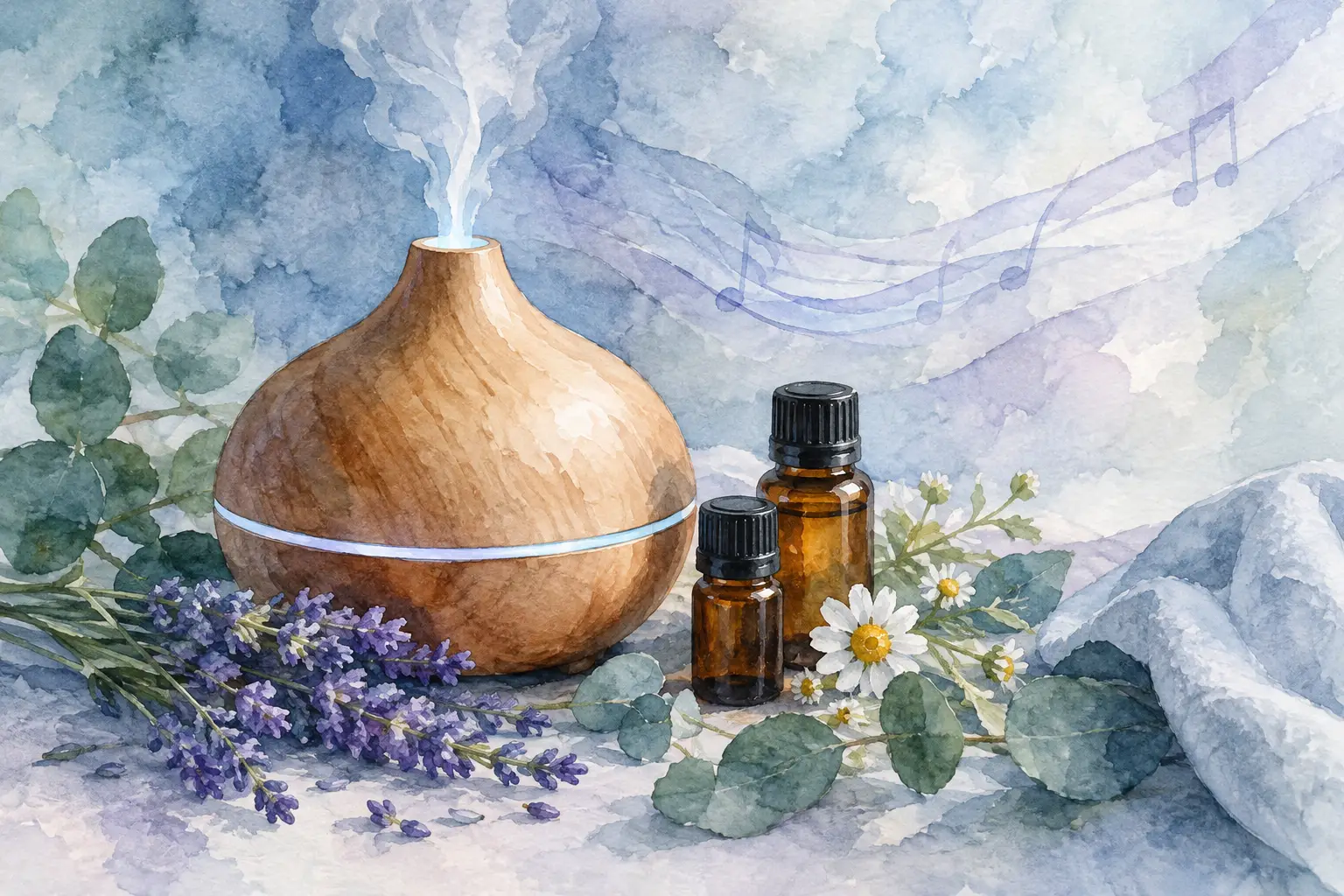
A diffuser can change the character of a room in minutes. Music decides whether that change feels held or scattered. The best music for aromatherapy sessions does not compete with the scent, the conversation, or the quiet work of slowing down. It creates a soft perimeter around the ritual: present enough to give the room shape, restrained enough to leave air between each moment.
This is less about finding a genre with the word “relaxing” attached to it and more about choosing sound with the right behavior. A beautiful track can still be wrong for aromatherapy if its drums arrive too sharply, its melody asks for too much attention, or its volume leaps from one song to the next. When the music is functional as well as expressive, you do not have to keep managing it. You can simply let the room settle.
What the best music for aromatherapy sessions does
Aromatherapy is sensory by nature, so music should support the sensory hierarchy rather than crowd it. The scent should have room to arrive first. Whether you are using bright citrus in the morning, green herbs while resetting your space, or warmer notes at the end of the day, the music can carry the pace without telling the experience what to feel.
The most dependable choices tend to share a few traits: a stable overall loudness, patient harmony, modest rhythmic movement, and no sudden vocals or dramatic drops. Instrumental ambient, slow massage music, gentle electronic textures, and understated lounge can all work well. The deciding factor is not the label. It is whether the arrangement gives the listener somewhere to rest.
A track with a warm low end can make a larger room feel less empty. Soft pads and sustained chords can create continuity between one breath, one cup of tea, and the next. Small melodic phrases are welcome when they appear like light through a curtain, then recede. Constant hooks are less useful. During an aromatherapy session, music should hold a room, not headline it.
Match the music to the shape of the session
Before choosing a playlist, consider what kind of time you are making. A ten-minute scent break at your desk needs a different musical frame than a 90-minute bath, a massage appointment, or an evening in a treatment room.
For a short reset, choose music that establishes calm quickly. A sparse opening, gentle pulse, and moderate warmth work better than an extended ambient introduction that takes fifteen minutes to find its center. There is nothing wrong with slow-building music, but it depends on how much time you actually have.
For longer sessions, continuity matters more than instant impact. Look for extended programming with transitions that feel related in tone and tempo. If you are a massage therapist or studio owner, this is operationally useful: no abrupt mood shift when you are focused on a client, no need to reach for the volume control midway through the appointment. A suite should be able to run in the background for the length of the work, with enough variation to avoid feeling like a loop.
At home, an evening session often benefits from slightly darker colors in the sound: low, rounded bass; unhurried chords; a rhythm that suggests movement without inviting the room to become busy. For a daytime shower or studio reset, a little more lift can be welcome. Think soft percussion, clean electronic tones, and a brighter harmonic palette. The goal is not sedation. It is an atmosphere that matches the light in the room.
Let the scent lead
A simple way to choose is to translate the scent into musical qualities. Crisp, fresh notes often sit beautifully beside clear pads, light piano fragments, or delicate percussion. Floral notes can carry a little more melody, as long as it remains unforced. Woods, resins, and warmer blends tend to suit deeper bass, slower chord changes, and less treble sparkle.
This is a creative prompt, not a rule. A bright citrus scent against deep, slow ambient music can be striking, especially after a demanding day. Contrast can make a familiar ritual feel new. What matters is that neither element overwhelms the other.
Avoid music that keeps pulling focus
Many playlists marketed for relaxation are assembled song by song rather than designed as a full environment. They may move from near silence to cinematic swells, from field recordings to prominent piano, or from instrumentals to a vocal track without warning. That variety can be engaging when you are actively listening. It is less helpful when the point is to notice the room, the scent, and your own pace.
Lyrics deserve particular caution. Even a quiet vocal asks the mind to follow language. In a shared treatment room, words can also feel oddly personal or change the tone for different clients. Instrumental music is usually the safer choice because it leaves interpretation open.
Avoid aggressive high frequencies, sharp snare hits, and wide dynamic swings if the session is meant to remain even. Silence itself is not a problem. In fact, open space inside an arrangement often makes music feel more expensive and more human. The issue is surprise. A sudden change can break the atmosphere you spent time setting.
Set volume once, then leave it alone
The right volume is lower than many people expect. You should be able to hear the music clearly without feeling that it has moved to the front of the room. If you need to raise your voice over it, it is probably too loud for an aromatherapy session. If the music disappears entirely under ventilation, water, or soft conversation, raise it only enough to restore its presence.
For professional settings, test the playlist from the client’s position rather than the reception desk or speaker location. Corners, tile, linens, and hallway noise all change what a listener hears. A reliable sound system and consistent track loudness make a bigger difference than chasing a perfect genre.
It also helps to avoid shuffle. Sequencing is part of the atmosphere. A thoughtfully ordered set lets energy rise and fall in small, natural increments. When you shuffle, you hand the room over to chance.
Choose long-form music, not endless searching
The best session music removes decisions. Build a small rotation of playlists that you trust, then return to them when you want the ritual to begin without a screen becoming part of it. One can be brighter for mornings, another deeper for evenings, and a third neutral enough for client work or shared spaces.
At Locuorio, I make instrumental suites with this kind of listening in mind: patient pacing, warm low end, restrained dynamics, and room for the scent to remain the central presence. The Weightless Suite is especially suited to massage, spa, and slower home rituals because it is sequenced as a continuous atmosphere rather than a collection of interruptions.
A reliable playlist does not need to be anonymous. It can have character, subtle melody, and a sense of place. It simply knows when to step back. That restraint is what lets a diffuser, a towel warmed in the dryer, a dim lamp, or a few quiet minutes become more than separate details.
Put on music before you begin preparing the room, keep the volume low, and give the first track a minute to settle into the air. If the atmosphere feels easy enough that you stop evaluating it, you have probably found the right sound. When you are ready, listen to a long-form Locuorio suite and follow on Spotify for more music made to hold the room.