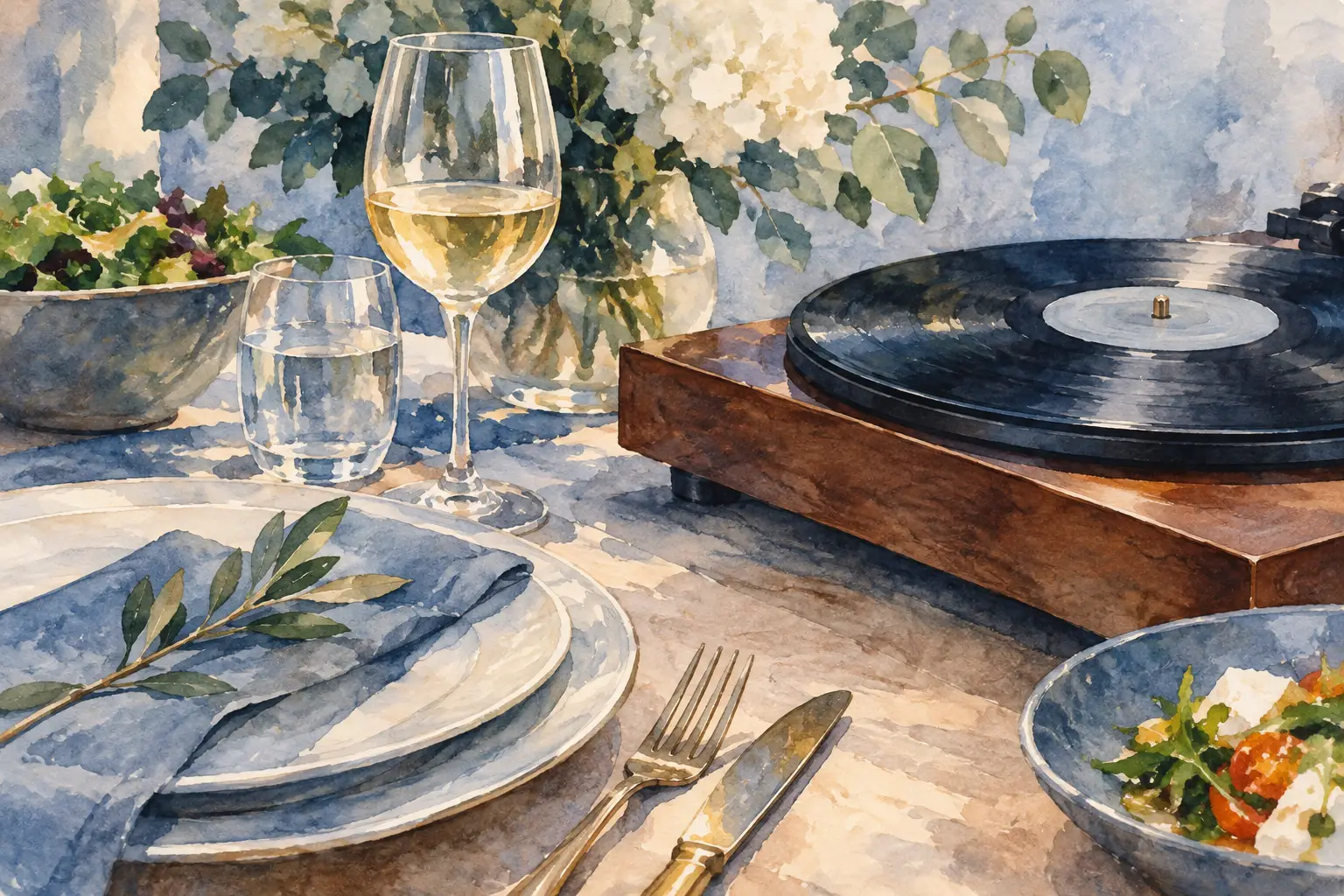
A dinner playlist has one job: make the room feel more like itself. Not louder. Not busier. Not suddenly nostalgic because a familiar lyric pulled everyone out of the conversation.
The best instrumental playlists for dinner create a soft perimeter around the table. They give a restaurant warmth before the first order arrives, make a terrace feel considered after sunset, and help a dinner at home move naturally from preparation to dessert. The right music is present in the atmosphere but absent from the effort of listening.
What Dinner Music Needs to Do
Dinner is not one mood. A weekday meal for two, a full restaurant service, and a long table of friends all ask for different energy. Still, the musical requirement is remarkably consistent: the music should hold the room without taking the center of it.
That is why instrumental programming works so well. Vocals carry language, memory, and a point of view. Sometimes that is exactly what a party needs. During dinner, though, lyrics can compete with conversation, especially in smaller rooms or spaces with hard surfaces. Instrumentals leave more air between people.
The sound also needs a stable center. Sudden drops in volume, dramatic intros, sharp percussion, and large stylistic jumps create small interruptions all evening long. A well-made dinner playlist favors measured transitions, consistent loudness, and arrangements that have detail without demanding attention.
I think of it as music with good table manners. It arrives on time, stays attentive, and never starts telling the best story in the room.
Best Instrumental Playlists for Dinner Start With Timing
The most useful way to choose dinner music is not by genre alone. Start with the hour, the room, and the pace you want guests to feel.
Early evening: light, open, and anticipatory
When guests are arriving or the first tables are being seated, the room needs a little lift. Choose relaxed lounge, soft melodic house, or understated chillout with a clear pulse and generous space. The tempo can be gently propulsive, but it should not push people toward the dance floor before they have found their seats.
This is the moment for warm bass, brushed or restrained rhythmic elements, and harmony that feels sunlit rather than sentimental. In a restaurant or hotel bar, early-evening music should help the room gather itself. At home, it makes chopping, pouring, and greeting feel part of the occasion instead of a rush before it.
During the meal: steady enough to disappear
Once conversation settles in, reduce the musical drama. The strongest dinner selections often have fewer obvious hooks, lighter percussion, and longer phrases. Guests should be able to pause, laugh, and speak across the table without leaning forward to be heard.
This is where sequencing matters more than a single great track. One beautiful piece cannot carry a three-hour service if the next track arrives with a louder kick, a bright synth lead, or an entirely different emotional temperature. A dinner playlist should feel like one continuous environment, not a collection of personal favorites shuffled together.
For longer dinners, look for programming with extended runtimes and gradual changes in color. It prevents the familiar problem of checking the queue halfway through the evening and realizing the mood has drifted somewhere else.
Later hours: add glow, not pressure
As plates clear and glasses stay on the table, a little more movement can be welcome. This is the right time for melodic grooves, deeper low end, and a touch more rhythmic definition. The distinction is important: more energy does not mean more volume.
A late dinner room can feel alive without becoming frantic. Let the music become warmer and more buoyant, but keep the arrangements clean enough that people can remain where they are. If the evening turns into a party, change the music deliberately. Do not let a background playlist accidentally make that decision for you.
Choose the Sound for the Space
A playlist that feels perfect through headphones may feel overly dense in a dining room. Rooms add their own instruments: cutlery, glassware, ventilation, footsteps, espresso machines, and dozens of overlapping voices. The more reflective the surfaces, the more carefully you need to manage volume and high-frequency detail.
In an intimate dining room, softer textures and mid-tempo tracks tend to travel well. Keep the volume low enough that a guest can speak to someone across a small table without changing their natural voice. If the music disappears completely, raise it slightly. If people begin leaning in, lower it. There is no fixed number that works for every room.
Terraces and outdoor spaces can take a little more rhythm because the sound has room to disperse. Still, wind and street noise often remove the quietest details, so a playlist built only from delicate ambient pieces may lose its shape. Choose music with a warm, audible foundation rather than aggressive peaks.
For bars that serve food, the balance depends on the service period. A lunch crowd may want brightness and ease. A dinner crowd often benefits from deeper, slower music that lets the lighting and conversation do more of the work. The goal is not to define the venue with a single genre. It is to give each hour an appropriate temperature.
Why Vocals Are Usually the First Thing to Remove
There is no rule against a vocal track at dinner. A familiar song can create a lovely moment. But a playlist made mostly of songs with prominent lyrics asks guests to process a second conversation all night long.
Instrumental music avoids that friction. It can still be emotional, rhythmic, and memorable, but it does not force a shared language into every pause. For restaurants serving an international crowd, that openness is especially useful. The music can feel expressive without assuming what anyone wants to hear or understand.
This does not mean the selection should become anonymous. Generic background music often solves distraction by removing personality altogether. A better choice has a point of view: warm low end, patient harmony, understated percussion, and melodies that appear, recede, and leave room behind them.
Build a Playlist That Does Not Need Managing
The difference between a pleasant dinner and a polished one is often operational. Staff should not need to adjust the volume every other track. Hosts should not be reaching for their phone while serving food. Good programming earns trust by staying consistent.
Before service or before guests arrive, listen to the first 20 minutes in the actual room. Notice whether the bass builds up in a corner, whether cymbals feel sharp near the bar, and whether a quiet track disappears under normal conversation. Then check a transition near the middle of the playlist, not just the opening. Many queues begin beautifully and lose their composure later.
Length matters, too. A 45-minute playlist creates repetition during a full dinner service, while a playlist that is far longer than the occasion can become unfocused. For a dinner at home, two to three hours is usually enough. For a restaurant, hotel lounge, or terrace, use longer programming that can carry the room through seating, peak service, and the slower final tables.
At Locuorio, I compose with those practical details in mind: restrained dynamics, unhurried harmony, and transitions designed to keep a room settled. Our LOUNGE playlist is made for the space between social energy and stillness: golden-hour music with enough motion to support a full evening, without stepping over the conversation.
Let the Meal Set the Pace
The menu can guide the music more usefully than genre labels. A bright, casual meal works with lighter grooves and clear melodic movement. A candlelit dinner often asks for deeper tones, slower pacing, and less rhythmic insistence. For a long shared table, keep the music welcoming and even, with no abrupt shifts that divide the room into separate moods.
There is also value in leaving a little silence around the music. Do not try to cover every sound. The clink of glasses, a chair moving, a brief pause before someone tells a story: these are part of dinner. Music should frame those details, not erase them.
Choose a playlist that gives the evening continuity, then let the people at the table do the rest. For more warm, long-form instrumental programming, listen and follow Locuorio on Spotify.